

Another of Nick Siders articles.
A Closer Look at the Pigeon
Birds have a lightweight skeleton made of mostly thin and hollow bones. The keel-shaped sternum (breastbone) is where the powerful flight muscles attach to the body. Birds have a smaller total number of bones than mammals or reptiles. This is because many of their bones have fused together making the skeleton more rigid. Birds also have more neck (cervical) vertebrae than many other animals; most have 13 to 25 of these very flexible neck vertebrae (this helps them groom their feathers). Birds are the only vertebrate animals to have a fused collarbone called the furcula or wishbone and a keeled breastbone. Below is a diagram of a typical bird skeleton.
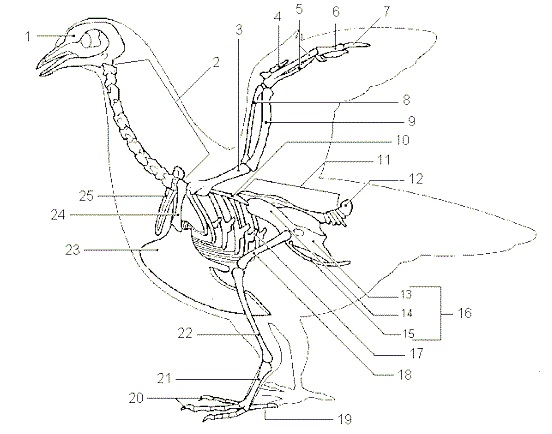
1) Skull 2) Cervical Vertebrae 3) Humerus 4) Second digit 5) Metacarpals 6) Fourth digit 7) Third Digit 8) Radius 9) Ulna 10) Scapula 11) Synsacrum 12) Pygostyle 13) Ischium 14) Ilium 15) Pubis 16) Pelvic girdle 17) Uncinate process 18) Femur 19) Halux 20) Digits 21) Tarsometatarsus 22) Tibiotarsus 23) Keeled sternum 24) Coracoid 25) Furcula (or wishbone)
While maintaining strength, most of the bones are pneumatic, meaning they are hollow and filled with air spaces connected to the respiratory system.
Skull
The bones of the skull are generally fused providing protection to the brain while being of light weight. A light, toothless beak replaces the bony, heavy toothed jaw of reptiles. Beaks, of course, can be highly modified for different types of food and feeding behavior (see Bird Beaks). Note the large orbits, as sight is an important sensory mechanism for birds.
Neck
The necks of birds are very important for body maintenance and eyesight. Modification for flight has rendered avian forelimbs almost useless for any task other than flight. To make up for this lack of forelimb dexterity, the beak is used for many tasks such as preening feathers. To access hard-to-reach feathers on the back and tail birds require a flexible neck. Furthermore, as birds have immobile eyes, head movement and flexibility is required to focus on objects at various distances.
Thorax and Sternum
Overlying flaps projecting off the ribs called uncinate processes help to stiffen the rib cage so it will not collapse during the powerful strokes required for flight. The sternum is the highly modified breastbone. In flying and swimming birds the keel is enlarged for flight muscle attachment. Flightless birds such as Ostriches have a sternum without a keel.
Pectoral Girdle
The pectoral girdle is made up of the sternum, clavicle, coracoid and scapula. The clavicles come together to form the furcula, or “wishbone”. The furcula provides a flexible attachment site for the breast muscles and along with the coracoids act as struts that resist pressure created by the wing stroke during flight. Flight muscles running from the sternum to the relatively short and stiff humerus elevate and depress the wing.
Pelvic Girdle
There is an extensive fusion of bones of the pelvic region to provide stiff support for the legs in order to deal with the stress of take-off and landing. The synsacrum is a fusion of the pelvic and 6 caudal (tail) vertebrae. At the end of the spinal column is the pygostyle, a fusion of the final few caudal vertebrae. The pygostyle supports the tail feathers and musculature.
Wing
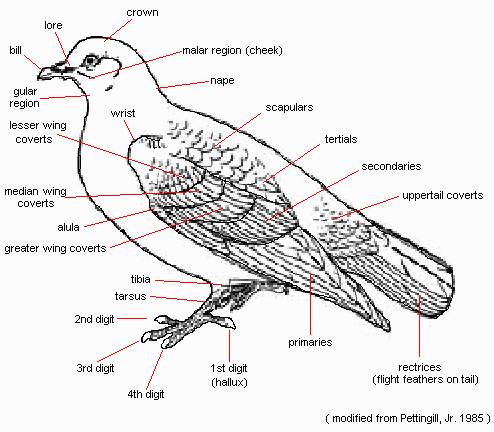
The avian wing contains the usual arm bones of reptiles and mammals, but in a highly modified form. The humerus is rather short compared to the total length of the wing, as it must withstand the pulling of the flight muscles. The radius and ulna form the support for the mid-wing. The outer wing or “hand” bones are highly fused for strength and feather support. The first digit or pollex supports the alula, a small feather used to control air flow around the wing.
Leg and Foot
The upper leg is composed of a fairly standard femur, but the lower leg and foot are highly modified by fusion of bones. Of course, between the femur and the fibula and tibiotarsus is the knee, whose location in birds is often confused. The tarsometatarsus is an extended fusion of the foot bones. This lengthening adds extra leverage for running, landing and take-off.
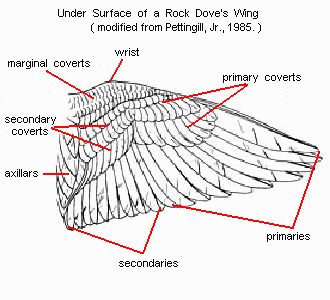
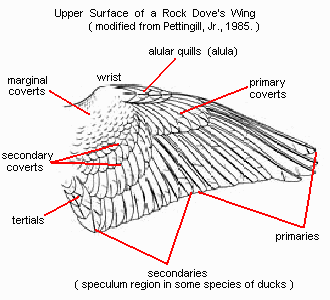 Under view
 Internal
Air Sacs
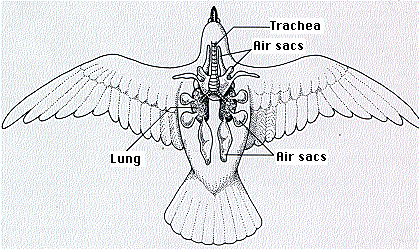
Most birds have 9 air sacs:one interclavicular sactwo cervical sacstwo anterior thoracic sacstwo posterior thoracic sacstwo abdominal sacs
Functionally, these 9 air sacs can be divided into anterior sacs (interclavicular, cervicals, & anterior thoracics) & posterior sacs (posterior thoracics & abdominals). Air sacs have very thin walls with few blood vessels. So, they do not play a direct role in gas exchange. Rather, they act as a ‘bellows’ to ventilate the lungs
Internal
Air Sacs
Most birds have 9 air sacs:one interclavicular sactwo cervical sacstwo anterior thoracic sacstwo posterior thoracic sacstwo abdominal sacs
Functionally, these 9 air sacs can be divided into anterior sacs (interclavicular, cervicals, & anterior thoracics) & posterior sacs (posterior thoracics & abdominals). Air sacs have very thin walls with few blood vessels. So, they do not play a direct role in gas exchange. Rather, they act as a ‘bellows’ to ventilate the lungs
 Close up view
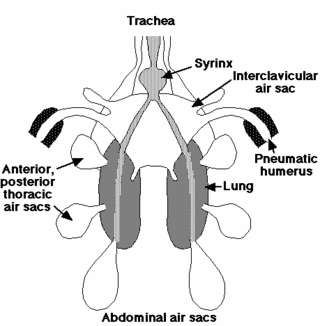 Pigeons cool off in the heat by releasing water in the air sacs connected with its lungs and of course by panting that cools the blood to the brain.
Digestive tract
Pigeons cool off in the heat by releasing water in the air sacs connected with its lungs and of course by panting that cools the blood to the brain.
Digestive tract

 and then