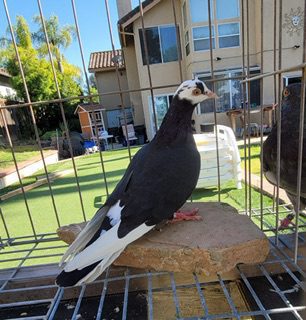
MY HOBBIE IN ROLLER PIGEONS
By Joe Stayer
I have been in the Pigeon hobby since September of 1942. Over the years I have tried many different loft designs in order to fly my birds. My favorite is the Mobile Loft that I have at this time.
When I was young very few people I knew had knowledge of pigeons. ‘I got my start from getting pigeons from the barns at St. Bonaventure University campus when I was very young. They had their own animals for food supply. A priest there had a garage full of pigeons and they strayed off and made nests in the barns. I used to go there at night and get pigeons sitting on the rafters. In one of the flocks I noticed a strange bird that flew in the air and it turned over backward. It was very interesting to see them in the air flying.
Over the years I was away from the pigeons. I married and spent two years in the army as a truck mechanic in Orleans, France. I often told my wife that someday I was going to raise pigeons when we bought our first home. On December 31, 1957 we bought a home with a beautiful 34 acre lot and a nice place to fly pigeons. In January of 1958 I met a man who gave me 3 American Pigeon Journal magazines. I needed stock and I learned first hand I needed to write letters or to travel, as there wasn’t anyone who lived near me that flew pigeons. I joined the URC and later NBRC, ERC, IRA and PRA.
My first contact was Allen Daniels of Grotz, PA and later I wrote Russ Harter of Ohio and many fanciers who were very knowledgeable in the hobbie. I contacted Dick Orr of VA, Emil Beck and Frank Rexroat of Illinois, Roger Baker of Ohio, J. LeRoy Smith of NY, C.L. Humphrey of Del, George Reeves of Iowa, W. Paul Bradford of Utah and Mac Nugent of Indiana. I also contacted Jerry Selinger and Monty Niebel of Canada, Tom Brown of Scotland and Bill Baretta of England. I also found Homerats fanciers such as Colonel Otto Miller who was in charge of the Pigeon Division of World War II. Each one of the above have taught me plenty of information that I couldn’t find in any book.
When I first started and for many years I flew out of my back yard and that worked great. One of the things that I noticed was that the birds didn’t perform in the air as well when a stranger came and had a different color apparel on. With my new way of flying from a mobile loft the birds only see me. They don’t learn one area and I fly them in city parks, parking lots or church and school yards so they come in contact with plenty of odd colors. Also I make sure I change jackets often so this problem has been corrected.
My family of Roller Pigeons came to my loft in June of 1958 and today there is only one other party that has them and it is a young man by the name of Harry Hellwig of Dansville, NY. I got him in the hobby 42 years ago. This family is from Bill Penson’s stock that came to me from Allen Daniel of Gratz, Pennsylvania. He didn’t develop his own stock as he got them from lofts in his country of England before he came to America in 1948.
Flying a Mobile Loft.
In April of 1970 I started to train my stock to fly from a loft on wheels. I start to train them the same way I used to do in my back yard. When it comes to location though I train them a little differently. Inside my breeding loft on all 4 sides I have a 3 inch circle painted with red florescent paint. You will see paint on the perches in the breeding cage. This way the young birds learn the color paint at an early age. In my mobile loft that I fly from it is painted blue and white which is the same as my house. On the outside, on the roof is sheet metal and I painted it with aluminum paint to take the heat off and make the loft cooler inside. On each end at the peak I have a strip about 15” long painted red fluorescent paint that is the same color I painted inside on all four sides and the fronts of each perch. This way my young rollers see all the same colors and realize where their home is no matter if they are flying or in the breeder loft. This color can be seen a long way away. They will keep circling in the air until they see my loft. Then they will fly above the loft until I whistle them down or until they come on their own after a long fly.
Breeding season starts from March 1st to July 31st. I always felt that later than this time the young can’t handle our cold climate in the winter. I usually band 50 birds each year. I keep the cocks separate until I decide to breed them. All my birds are half cousins. When breeding season starts I open the slide door I have that separates the cocks and hens to let them start breeding. I let the cocks call the hens into the nest. They have nest material available in one corner of the breeding loft. Each compartment has 16 nest boxes and I have 16 pairs of breeders. I know what kind of birds I will get from years of breeding from a certain color pattern. The reds spin the best and black fly the best. I have them both in my family. In a kit you will need color balance. My roller stock has a very good homing ability.
I train my young rollers at 4 weeks of age. I remove them from the nest at 2 weeks of age and put them on the floor. My breeders are fed chicken growing crumbs. I have a feeder available so the young can be fed at any time of the day by both parents.
Late afternoon I give a few handfuls of red wheat. I throw this on the floor and whistle for the birds to come eat. This is my first training session. The young learn to eat grain, drink water and eat grit. It is important for them to learn my whistle as I use it for calling them to eat and trap at the age of 4 weeks. They will learn trapping to the mobile loft after dark. At this date the young rollers are put inside the mobile loft. I have 4 compartments in my loft. Each compartment holds 25 birds and perches for them. The front end holds my hold over kit where I have a trap system. They can be released from the large door and trap into the small door and can’t get out. In the rear is where I have a drop system. The birds are taught to come out at the small door and sit on the door platform in a wire cage for one week. From Wednesday on I open the trap door and remove the screen from the door and have the birds semi hungry but give them no water until evening. About 2 hours before it gets dark I let the young birds come out of the loft on the platform and if they like they can fly up on the loft roof and look around. When it gets dark I call the birds back inside the loft. Now these birds are fed red wheat only. I feed all the birds 2 rations so they keep being hungry. After all the birds have eaten I give them a drink of water in a pan and remove it until the next day. On the 2nd day I open the loft door one hour before it gets dark. The birds come out of the loft and fly around the yard, on the house roof and back on the loft roof and back inside when I whistle for them to come and eat. Each day is the same in feed and water. On the 3rd day until the 6th day about 1 1⁄2 hour before it gets dark I open the small loft door (blue). They come out and fly in my yard, on the house roof and back on the loft roof. I do not fly them on Sunday so I put a pan of water on the roof so the birds can take a bath if they would like to. Where we live we have a lot of cats so you have to watch them so nothing will kill them.
I then move the loft for the first time to the city park where there is a lot of activity in the evening and it is still daylight. I open the large door and take a stick with a red cloth attached to it like a flag. I slide the flag into the compartment and scare every bird out into the air. They fly all over the sky with some landing on buildings and some on the loft. At this point if it gets dark and I don’t get all my young birds back inside the loft I do not get excited because I have learned that you have up to 4 days before the birds are lost.
I have my birds banded on the left leg with the NBRC plastic coated band. On the right leg I have Joe–372-4705 on a plastic coated band. If the birds get lost and get hungry they will drop down so someone can read my name and phone # and call me about my lost bird. I usually get them back on either the 2nd, 3rd, or some on the 4th day. They never get lost again and I increase the feed and start to fly them daily. I like them to work for 30 minutes in the air.
You increase the feed if they go out into the air and drop very soon back onto the roof. You decrease the feed when they refuse to trap after flight.
.
Every day is the same from here on in and regardless where to fly them. If you lose any birds go back to this area 4 days in a row either in the evening or the morning; whenever you have time to spare.
When the young birds are flying good and trapping good I install my new trap system so they can’t slip out on me once inside.
I feed one tablespoon of Red hard wheat once a day until after a month in the air. I increase my flying time to twice a day and I feed twice a day continuing up to 6 months.
I feel with my experience in a mobile loft that one can fly his birds wherever he wants to with no problem at all.