
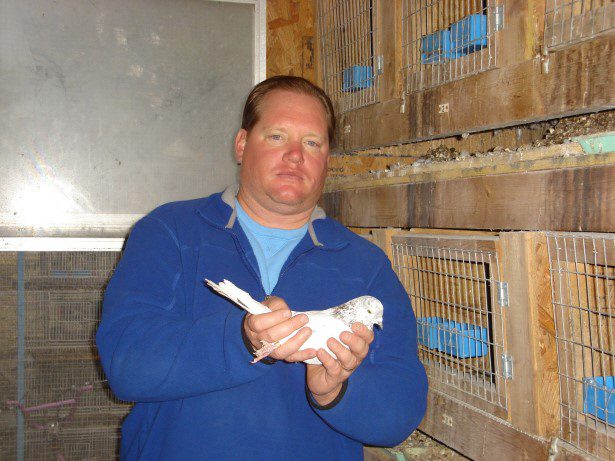
By: Rick L. Mee
Concert performance in rollers is defined as 5 or more rollers rolling at the same time together. The ultimate goal, or as it should be, is to get 20 rollers to all roll at the same time, a minimum of 10 feet, the deeper and faster the better. Most top roller fanciers will agree that the ultimate depth that a roller can withstand the roll, and still be able to retain its tight tuck position, is about 40 ft. It takes most fanciers years of trial and error before they can develop such kits, and it seems that other fanciers were born to it. Although it appears that roller flying my be an easy endeavor, most never unlock the true potential of the roller pigeon in its ultimate form, that being a pigeon that does all of the necessary things we require such as kiting ability, speed, style of roll, depth etc. There is one little ingredient that is seems is never taken in to consideration, and that is the desire for the roller to do it collectively.
So how do you breed for concert performance? It is so easy, has been repeated several times, but very few follow the advice of those obtaining it now, or have obtained it in the past. There is only one way of obtaining concert performance in your flock, and I am about to discuss with you what I have found is working for some of the more prominent flyers in the World.
It all starts with shrinking your gene pool in the beginning. Preferably, starting with only one pair of proven breeders, which both excelled in the air in every way imaginable. It will be necessary to use fosters in the beginning so that you can raise as many as possible from this click pair. Discipline yourself to not stock any of these youngsters until you have flown them for at least 18-24 months. If you do this, and only allow those who lasted this long, you will always have strong stable spinners. Once these youngsters out of the click pair have made the grade, select the top cock to mate back to the mother, the top hen back to her father. Once you have done this, you can develop more pairs if you so desire. Never allow anything else in to your newly developed family, unless someone else’s family of rollers has a very strong attribute that your birds are definitely lacking. To intensify your gene pool even more and the system that I prefer over the aforementioned, is instead of using the original hen from the click pair, eliminate her all together, and only mate the best daughters back to their father. This will force you to create a family solely out of one bird, and of course this cock must be awesome in every way. You will need foster parents to pull this off. This is called polygamy breeding, and in its purest form.
In doing the above, what we create is a flock which are all similar in type, require the same amounts of feed, react the same to different grains and kit very tightly because of the relationship to each other within the kit. When you fly rollers that are this close in relationship to each other, there is an automatic mental connection between each bird in the kit because of their closeness. Of course, there are a hundred other reasons that the above mentioned breeding practice works, I have only mentioned a few. The main one and one that few rarely mention is called kit chemistry, and is achieved when those who are worthy of the competition team are flown together for a long period of time. The only changes made to the competition team are as a result of a casualty, one is removed for breeding, or one of the young birds has proven itself to be better than the lowest quality bird in the competition team. It is a progression game we play with rollers, and should always be searching for the youngster to move up to the competition team, to make them just that much better. Try to not make changes to your team at least 1 month prior to an important fly, as it will take a few weeks for the kit to fully act as a team again after a change has occurred.
Through correspondence and many loft visits, I have found that the more consistent flyers are all flying kits, which were derived from just a few rollers in the beginning. Haphazard and countless mating of different families, later to have their young flown together only leads to kits that roll individually, or at best not collective enough to bin big competitions.
These are only my opinions, I hope someone gains something from it.
 and then