
GETTING STARTED In ROLLERS
By Jim Petersen
Welcome to the best Roller Club you could have joined. We are sure that you’ll find your membership helpful and enjoyable as you learn more about your Rollers through our bulletin and also join us in our club activities. The purpose of this paper is to answer any of the initial questions you may have if you are just starting out in the roller hobby. Your rollers performance is determined through your flying/feeding program, how the birds are housed, and the quality of your foundation stock. This is only a basic guide and a recommended way to get started. Everyone has their way of doing things based on several things:1) The family of rollers they have.
2) The weather and other conditions they fly under.
3) The way their lofts are configured. If you are just starting out and don’t have a loft built and don’t have any birds yet you might be in the best position of all.
It takes patience not to want to rush into getting birds and get started. The best advice might be to take it slow. Patience is Something that you will need as you spend time with Rollers anyway. Go to as many lofts as you can in your area. Study the various loft setups you’ll find birds in the air. The fanciers will be happy to fly for you, and basically pick up all the knowledge you can before you ever drive that first nail or br that first few pairs.Housing
Rollers need very little room compared to most breeds and the loft need not be elaborate to insure success. We can’t emphasize enough that a neat and clean loft setup will carry you well in your relationship with your neighbors. Keep the lofts painted and add a little landscaping(flowers & bushes) to help keep the complainers away. As you clean your loft of droppings no less than once per week, always remember to wear a good quality mask designed for pigeon dust to prevent the breathing of too much harmful dust. It just makes good common health sense. N95 mask minimal or 3m half mask with 2097 filter. A kit box or pen that measures 3’X3’X3’with box style perches on two walls measuring 12″ long and 8″ high out of 4 inch wide stock, is perfectly adequate for a kit or flock of 18 Rollers. There are several types of perches that work well for rollers. The “V” perch (3″ X 1″ material nailed together to form an upside down ‘V’) keeps the birds cleaner than some perches. The box perch helps to keep the birds calmer. Always have one perch per bird in any of your lofts. Most fanciers use traps, metal bobs that swing in but not out. The trap section is cut out of the larger release door. A trap can be any size, but a 12″ or 6″ width that is 6″ to 8″ high will work fine. You can use this cut out 12″ X 6″ section as a door by hinging it. This hinged door is also a landing board by using angle iron to hold it half way open. Some like to have their birds re-enter the kit pen after they fly through the door they were released from without the use of a trap. They use feed and a gentle whistling to get them in. This is called the English method. It’s very effective, but it’s also nice to have them trapped trained to allow stragglers a way to get back in. ALWAYS close the trap as evening falls. Some fanciers like to have 1″ X 1″ hardware cloth for the floor area of the kit box. This allows the dropping to fall through to a tray that they can clean at their convenience. If the holes in the wire floor are larger vermin may cause problems. Many Roller flyers prefer a solid floor that they scrape out once or twice a week. Kit boxes should have some sort of ventilation holes or opening slits under a roof overhang (so that rain or snow will not readily blow into the loft and make it damp inside).These are usually at opposite ends of the pen to promote the flow through of air. Good ventilation will keep your loft and birds dryer and healthier. There are a number of diagrams and floor plans for Roller lofts in many of the books that have been published on the subject. Keeping the kit birds or flyers in a low light or dark situation will keep them less likely to mate when not flying. More and more Roller fanciers like individual breeding pens for their Rollers. This assures parentage and helps achieve better egg fertility. If the pairs in the individual pens can see other pigeons they will respond with better parenting and better fertility rates. An individual pen, 2′ wide, by 3′ long and 2′ high is adequate. Some prefer to attach a small wire (hardware cloth) walking pen which seems to enhance fertility. The walking pen is a good place to place the water as it’s away from the dust and won’t contribute to dampness inside the pen. Individual breeding pens can be somewhat larger than this, but not much smaller. If the pen height is lowered, the males cannot properly copulate with the hens and a higher percentage of infertile eggs will again be the result. The more light they have, the more they will mate and they will thus have a better percentage of fertile eggs. The nesting area should have a one foot deep shelf with a nest bowl(the paper ones are perfectly fine but need to be changed periodically). The nesting material can be pine needles(fairly stiff needles around 3 inches in length work well) but tobacco stems (if not too heavy), hay or straw (is changed with each clutch or round of eggs) may also be used. The baby Rollers called “squabs” do need a good nest for warmth and also support. An open breeding loft is a loft of several pairs of Rollers that nest in boxes but have an open area where they can feed, mate and fly around. This type of setup is harder to get the pairs settled into initially. They try to mate with other birds around the loft and they tend to mistakenly fly into the wrong nest area the first week or so causing fighting. They will often try to return to last years mate also. There is also a jealous that certain cocks will demonstrate by breaking up pairs that are copulating or mating. Many times they will mate with the interrupted hen when she is in the mating position (much to the chagrin of her mate) and parentage is always a question then. The statics on this varies depending on what you read. We have read that promiscuity results in 50% illegitimacy in an open loft system. After many years observing rollers and using genetics to double check the results in the breeding pens, you can expect illegitimacy in 15% – 25 % in the first round and improvement as the season wears on to 10%-17%. Unless DNA is used to truly make this determination, it’s somewhat of a guess work, but be aware of this possibility as you decide on how you will build your performing Roller stud of pigeons. Many good lofts have been built using either the open or individual breeding pen methods. Once the birds are settled down in an open loft system, they are actually easier to feed and water since you really have only one large pen to care for. Just to give you some idea, a breeding section that measures 4’x8′ can easily handle 8 -10 pairs of breeders, especially if it is connected to an aviary or fly pen. Nest boxes will measure 2′ wide, 2′ deep(with a 1′ shelf built in the back of the nesting area) and 2′ high. Keep ceilings low so that birds can be caught easily. Low ceilings will also keep them a bit calmer and less likely to try to escape. A ceiling of 6-½’ should be the average. Most Roller people arrange their loft so they have 2 roomy holding pens ( one for cocks and one for hens) for their stock birds to live in when not in the breeding loft. STOCKING THE LOFT & BREEDING Fanciers are prone to changing the configuration of their lofts as the years go by as their needs and the perceived needs of their birds change. They are less likely to jump from one stud or family of Rollers to another very often and this is as it should be. Once you are underway, always have quality performance as the prime reason behind adding a bird to your stock. The key to starting a loft of Rollers is to know what’s out there and to see as many birds as you can in the air before making a large commitment in either time or cash or both. Some people like high flying birds that fly for long periods(over an hour).Others like birds that do not fly more than 15 -30 minutes but are constantly busy working and as a result don’t fly high. Some don’t care too much about the overall work of the kit, but do like very deep and breathtaking Rollers. There are Roller competitions at the local, state, or regional, national or international level. The entry fees and the overall degree of seriousness connected with each of these levels of competition flying goes up with the number of flyers involved. Generally, a tight kitting group of Rollers that perform frequently (once per minute or more) and in unison are the kind that runs up a better point score. This type of bird is usually in the 15′-25′ range of spinning depth. Points are additionally given for quality rolling. We don’t wish to examine the whole flying competition issue here, but did want to point to this activity as being very big among fanciers around the world. Needless to say, everybody loves Rollers that will roll incredibly fast and tight like a spinning ball. Observing many Rollers in the air will give an eye for what you want. Roller people are very happy to have the chance to start a new fancier. This start may be in the form of 6-8 pairs of breeders (the number needs to really give you the chance to produce some young) or an increasingly popular method of starting someone out with a young kit, usually a whole round of 15-20 birds, right out of the best pairs. Always handle and breed any such birds according to the wishes of the fancier you got them from. This will give you the best results and keep you in good graces with your mentor as you learn to grow in this great hobby. Stick with birds from one good source. Getting a bird here, there and everywhere will waste time in the long run. Mate the pairs up at the same time so that you have a group ready to wean together. The breeding season starts anywhere from December 1st to March 1st, depending on the weather.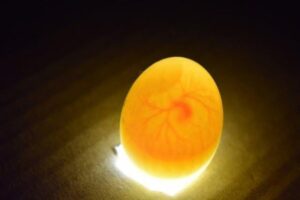 After they have laid their eggs, wait for ten days before checking them for fertility with a flashlight. Gently remove the eggs holding it so that parents’ wings slapping will not harm them. Hold it in front of the flashlight in a darkened area of the loft. (Note! Don’t check eggs at night time for a threat of startlening the hen off of the nest and thus allowing them to chill). A fertile egg will have a dark look to it and you will notice an angled air pockets near the top(smaller pointed egg) An infertile egg will be clear and translucent(you may want to check a chicken egg out of the refrigerator if uncertain). An egg that was fertile at one time but is now rotten will be dark colored perhaps, but the top will be liquid and the air pocket will be at the top.
At this ten day period is a good time to switch eggs to foster parents if you are inclined. If the eggs are found to be infertile, throwing them away will allow the hens to get back on cycle and lay again within a week to 10 days.
There are many good families of Rollers around today and the performing Roller is better than ever. The key is to start small; really learn all you can about the birds you have before fooling around with other families or trying to handle 4 or 5 kits(unless you have unlimited time to spend with them). Getting to know what makes the best birds in your loft is the proven way to build a good family and to develop even more of the kind you like. Be patient and don’t expect champions overnight.
After they have laid their eggs, wait for ten days before checking them for fertility with a flashlight. Gently remove the eggs holding it so that parents’ wings slapping will not harm them. Hold it in front of the flashlight in a darkened area of the loft. (Note! Don’t check eggs at night time for a threat of startlening the hen off of the nest and thus allowing them to chill). A fertile egg will have a dark look to it and you will notice an angled air pockets near the top(smaller pointed egg) An infertile egg will be clear and translucent(you may want to check a chicken egg out of the refrigerator if uncertain). An egg that was fertile at one time but is now rotten will be dark colored perhaps, but the top will be liquid and the air pocket will be at the top.
At this ten day period is a good time to switch eggs to foster parents if you are inclined. If the eggs are found to be infertile, throwing them away will allow the hens to get back on cycle and lay again within a week to 10 days.
There are many good families of Rollers around today and the performing Roller is better than ever. The key is to start small; really learn all you can about the birds you have before fooling around with other families or trying to handle 4 or 5 kits(unless you have unlimited time to spend with them). Getting to know what makes the best birds in your loft is the proven way to build a good family and to develop even more of the kind you like. Be patient and don’t expect champions overnight.
 and then