
By Carl Hardesty of Lewisport, Kentucky
Published in the American Pigeon Journal – 1987
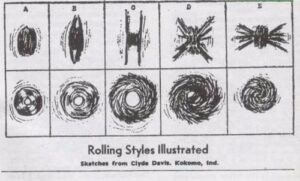
Standards for whatever they are worth are in my mind only if they help establish a better product. For years the hole in the side and the H position of the wings seen from the front, back or underneath have been the accepted teachings as per quality for grading a spin. I for one follow my own goals and that being straight and as fast as possible. That summary of my standard is only the result of the after product, for I have never seen, to my knowledge, a fast spin that was not without extreme tightness. The straightness of the spin I would like to a yo-yo or as the old saying goes “being able to spin through a 6″ drain pipe” or the wheels of a train as they move along the tracks.
The point being STRAIGHT, yes straight as a level line with no twisting and turning (changing wing action). Now, if the angle of fall is not perfect it doesn’t matter to me and what I mean by angle of fall is while one might draw a straight line at 180 degree another might do the same at say 160 or 200 degree angle of fall but all being straight. And before I make myself misunderstood, try to see a large circle in the sky and the spin starting in the center of the circle and while yet straight fall at different angles, of course 270 or 90 would be the flight of the bird or one spinning in 60 mile an hour wind whichever you like.
Fluid is a great way to describe a perfectly well-balanced, straight spin. The twisting and turning in the spin is anything but straight and balanced and I believe is the effort of the pigeon to break free from the roll but unable to do so by the compelling urge to roll.
Control is spoken in terms like rolldowns, bumpers and stable but the twisting and turning is also, I believe, the effect of lost control. While yet a different type of control or confidence, it is still there. Some birds will show very little loss of this control and others struggle to overcome it for up to a year or more and last but not least some never do.
Speed is just as important and in my mind goes hand in hand with tightness of the tuck in the roll. It is for this reason I no longer look for the hole in the side of my best spinners although I do on occasion see it. What I look for is the outer circumference of the spinning pigeon and the smaller the better.
A good standard for tightness is the appearance of a softball spinning at great speed and falling. I have seen tightness as small as a baseball, or I call them snowball spinners. The tightest of all spinners don’t show a hole in the side because they are drawn up past this point. The hole in the side most likely will be seen in the spin of the smallness of a softball. These spins I have been talking about — it should be understood that the wings are not seen from the side view because of the great speed and tightness of the tuck. Any time you can see the wings from a side view we are not talking about a fast quality spin. The wings from the front, back and underneath viewing are, I believe, the most misunderstood. I have seen so many rollers in the H position, it is not worth telling all. An example would be a cock that Jerry Boehmann has flown in our area the last year or so. I can’t ever remember this pigeon ever spinning in the H position but I can remember a great number of outstanding quality performances by this cock known as “Whiteside” and I can recall on one occasion he dropped about 10′ looking like a snowball and other times I have seen him go 40′ looking great, but never the H position or the hole, at least while I was there.
What value is the H position? And do the wings stroke while the pigeon is in the spin? If they do stroke, what kind and how much? Is the hole and the H position the end of the rainbow for performance? I for one don’t think so! Yes, I have seen some truly outstanding spinners with the wings in the H position and some with the wings looking like knife points, but where is the merit of this performance other than personal preference. I don’t believe the rollers that Bill Pensom and the other old timers were flying were of as high a standard as some of the best we have today. I believe this was confirmed by Bill Barrett in the tape that Rick Schoening produced for us. If I remember correctly the English fanciers regard the hole as an old standard which has outlived its usefulness.
Bill Pensom and the other old timers did a great service for us in bringing these fine pigeons into this country and developing them to the standard they were able to come to in their lifetime.
But.. that standard was not the most possible quality level these pigeons are capable of! I believe only in these last 10 years or so have a few selected fanciers started to produce this standard or quality. This new family of performance rollers being several generations removed from the old imported birds require a higher standard quality grading system. Those old standards were fine in their day as were the birds and the fanciers, but today is today and then was then.. In my travels I have noticed one thing and that being that those that hang onto the old ideas produce the quality of old gathering up as many as possible of the old birds as close as possible to the original birds, standing still if-you will. The other side of the coin being the fancier that doesn’t care if his birds have this number bird or that one in the background but that they perform to the greatest quality standard, this is where I have found the most outstanding spinners.
When I speak of these quality levels it should be noted that we should not expect to produce a great number of these spinners that are of the best quality. Every bird we raise and fly should be examined to our satisfaction as to keeping, culling and breeding. One spin does not a champion make! It is the long run that makes a keeper and breeder. In the second year of flying (if they are good enough to keep that long) is when the test really starts. Will the pigeon still be frequent enough? Has the quality dropped off a little? Out of 10 spins how many are still pleasing? These are questions we should ask ourselves as we continue to evaluate our flyers The group of young birds that we started with after one year has decreased in size greatly if we cull vigorously, now into the second year the culling continues and the group of birds from that year is even smaller and yes, as we continue to fly them we are still evaluating them, year in and year out. When evaluating rollers their condition should always be taken into account. Are they molting? Are they a little under the weather? The older birds should have a lot of consideration before culling because they didn’t last that long in the kit by spinning sloppy and just flying. Think what could possibly be wrong and that you yourself have done wrong that cause a problem for the bird.
Yes, these are some high standards and we should not expect our birds to perform at this level day in and day out. But it does give a means to be able to correctly evaluate a spin as to its quality level. If we only have one bird that on occasion spins of a high quality, it is no reason to cull the rest but it does give us a guideline as to what is possible Our goal is to put as many as possible into our kit and continue to build year in and year out. Don’t look for a great kit of birds in one year’s breeding, it takes time and effort. If the wings can be seen from the side view it does not mean the bird is a cull but if it looks as big as a basketball.. cull it! Remember… STRAIGHT.. Fast… and have a lot of patience. All persistent wing changers after not more than one year should be culled, many a lot quicker. Have you noticed I haven’t said a thing about depth, well…it is only and I mean only important when the quality is there first. Go for it.. .now build a kit that comes up to the standard.. yes, a real performance standard for Performance Rollers
 and then